Showing posts with label voyage peche. Show all posts

Friday, 4 April 2014

Spring salmon fishing on the rivers of Kola Peninsula.


Part 1

Salmon season  on rivers Chavanga, Strelna and Varzuga begins in May. This period is characterized by high water levels in rivers, cold water and big quantity  of fish. With the increase of water temperature of 6-8 C   salmon becomes active and reacts to artificial flies. Therefore, for many anglers last May - first June weeks are the best start to the season.

The problem is that spring comes every time another. Therefore, the situation on the river almost never repeated. Keep in mind that the simplest combination of temperature and water level is complicated because we have to take into account a host of other factors. One of the most important is the dynamics of these factors. For example, the high temperature of 18-20 degrees is not a threat to the activity of the fish. But if the temperature is increased in a few days, then it will lead to a significant decrease in activity.
This is the case in the spring, a sharp change in transparency, water level and temperature decreases   fish activity. A very important factor is the state of the rivers in the winter. Especially dangerous are  hard frost  and  freezing of the  rivers. Drastically reduces the number of suitable sites for salmon. A considerable part of the fish may die under the ice.. The transition from winter to spring is often strongly influenced on    spring fishing. The rapid melting of snow and ice leads to a very intense lifting and movement of water and  ice. Traffic jams of ice, which is deprived of the salmon sites. Part of the fish is killed by  stormy spring break.

For these reasons, the behavior of salmon in the new season may significantly differ from the picture that we remember from last year. The fish can be different in temperament, others positions  in the river, and a completely different reaction to our flies. Therefore, our last year's technique, fly, which we had placed so much hope, work is not as good as last year. Every year we have to try to understand what has changed in the river, what factors were decisive for the behavior of salmon. Then we have a chance to choose the right tactics for fishing, identify promising places to find the best equipment and gear.


  Part 2


The main problem that we face in the spring - is a high water level. In a large volume of water is difficult to navigate and find parking salmon. The river changes its nature, salmon chooses way to go up the river and places to stay  that are not obvious to us  .  Most often we have to use tackles  that   can bring  our  fly closer to the bottom. Here there are four choices,1.  use a heavy line (leader) and a heavy fly -.2.  use only   heavy line,3.  use a heavy fly on a floating line 4.  and use special techniques presentations that allow you to omit the fly sink. The correct choice between these options or the right combination determines the success of catching salmon. Given my own experience, I would suggest using a normal fly on a sinking line for use in such areas of the river where we can not confidently know   where salmons are staying.  . In this case, we have to present the fly over a wide area. This option is suitable for fishing on the broad reach, it allows you to quickly test a large area. Sometimes we find a good place in which salmon attack one after the other. With high water levels cause accumulation of fish in a certain place is not clear to us. But in the summer, we often find in this place - for example - a few individual stones that served as a hiding place for salmon in the spring.  If we know in advance about the existence of such anomalies at the bottom, we can greatly narrow down your search and do not waste time fishing in unpromising places of the river. This is the right place to apply the floating line  and heavy flies. Floating line  facilitates casting and management of fly, and weight allows it to fly down towards the bottom. In this situation, we do not need to check   large area, we can focus on fishing in a particular location. If we can apply the casting upstream or casting slack line, we will be able to   deep  the fly to the desired location. Mending of varying intensity is very useful  to achieve the same goal. If you use the   upstream  mending  - fly reduces the speed downstream and an added opportunity to dive deeper. If we do Mending downstream, we make fly to move  across with increasing speed. This technique can cause salmon, but more often it is suitable for the first version, in which we have to handle a large area.


Part 3.

  High and cold water, season beginning, end of May – early June.

Location 1

Fishing at the  very deep places , large depth, big volume of the water,  the main stream, under rapids holes , deep plum.
Bottom  fishing by fast sinking line and large  heavy flies.
Flies -  2-inch copper tubes, Waddington and other heavy body, wing length  up to 10-12cm.
Colors are mostly bright, contrast, in the wing of a combination of red, yellow, black with bright elements on the body flies.

Location 2
  Slow, not a very deep pools, clamps along the river, small holes where salmon stays for rest.
Fishing near   the bottom,  sinking line  and flies   0.75-1.5 inch brass tubes, Waddington and other bodies  are not very heavy, wing length up to 8 cm.
Bright enough,   wing -  combination of red, yellow, green, black.


The very beginning of the summer, the water is still high and cold, but becomes brighter and the level falls.  First weeks of June.

Location 1
The same  deep places , large depth,   bottom  fishing by fast sinking line  at the main stream, under rapids holes , deep plum.
Flies -  0.75-1.5 inch copper tubes, Waddington and other major carriers, wing length up to 8 cm.
Bright enough,   wing -  combination of red, yellow, green, blue, black with bright elements on the body flies.

Location 2
  Slow, not a very deep pools, clamps along the river, small holes, fishing near   the bottom,  sinking line.  
Flies   0.75-1-inch brass tube, Waddington and others not the heavy  carriers  and single hooks № 2-4, wing length up to  6 cm.
The wing is dark, but with bright elements, too bright elements on the body flies.


Summer takes effect, light and water drops, warm up to 10-12 degrees.

Location 1
Deep places near the main stream,  large depth,  under rapids holes , deep plum,   means bottom  fishing by fast sinking line.   
Flies   0.5-1-inch brass tube, Waddington and others carriers,  double and single hooks № 2-4-6, wing length  5 cm.
The wing is mostly dark and bright elements on the body flies.

Location 2
In a  slow, not deep water we use  undersurface  fly on a intermediate line.   
Flies   0.5-0.75 inch brass or aluminum tubes and other light carriers, single and double hooks № 4-6, wing length and 5 cm .Wing dark, bright elements on the body flies.


Friday, 15 March 2013

July salmon fishing. Strelna river.


In the middle of summer, in July, most of the Strelna river  salmons go  above waterfalls, climbs into the open stretches and small rapids. In the lower part of the river are the fish who have found shelter under the threshold and in the depth of the pits by the waterfalls. At this time  fresh   salmon goes up  from sea. They can be caught in the lower areas near the estuary of the river. But upstream salmon trying to go faster, higher and further upstream. For 6-8 kilometers up from the camp we can  found fish in the deep reaches of the pit and the rocks. In such places, accumulated a significant amount of fish. Here you can watch a mixture of salmon that were in the river throughout the season, here  are the brown giants from last fall and fresh summer silver salmons in the company of small grils.


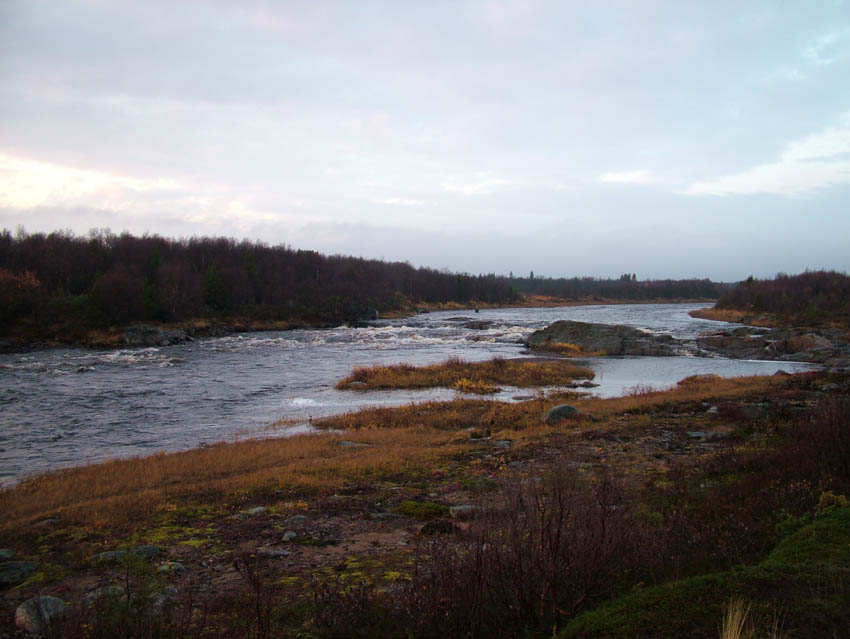
The photographs show how the river Strelna changes. Here are no   rocks and waterfalls, the river is located in a wide valley.
I am sincerely grateful to Patrick for    great photos!


atlantic salmon, peche au saumon Russie, pesa peninsola di Kola, pesca a mosca, Pêche au saumon atlantique, pêche à la mouche, Red Francis, salmon fishing in Russia, salmone atlantico, voyage peche


Tuesday, 12 February 2013

Taimen fishing. Giant fish. Tugur river. Habarovsk region.

Taimen fishing. Giant fish. Tugur river. Habarovsk region.


 Habarovsk region of Russia is sparsely populated, remote area. The largest rivers (Uda and Tugur) proceed on boggy valleys and have close to flat character. On the contrary, many of their inflows present mountain rivers. Bichy river is smaller, convenient for flyfishing. In Uda and Tugur till now a lot of large Siberian taimen. Uniqueness of these taimen consists that it can eat numerous here a Siberian salmon. The forage abundance allows a predator to reach the huge sizes. There are authentic data on capture here fishes in weight in 70 and even 95 kgs! And more than 30 kgs here catch fishes in weight annually. Except taimen, to fishers are interesting lenok, Amur grayling, sig-hadary and the Amur pike. 


            The most extensive area among all kinds of sort Huco possesses Siberian taimen. Within river pool this fish can make far migrations. The typical annual cycle includes wintering, spawning migration, a summer food and autumn leaving downstream. Spawning migration from winter parking begins with rising of water in the river in April and May. Fishes leave the main river and come into inflows having mountain character. Spawning proceeds in May and first half of June. In large inflows fish can remain all the summer long. In the summer fish keeps on weak, sometimes on an average current in holes and on reaches. Sometimes fish comes into flowing lakes and old channels of the rivers with stagnant water. In the autumn in small water fish is more often on a waterway. At lifting of a water level fish leaves from a current in places where water is purer. To search for it is necessary in old channels of the river. Activity of fish changes in a season current. After spawning it is active. In hot summer months from the beginning of July it ceases to eat. The biting improves after a rain when small animals get to water. It is noticed that fishing begins difficultly in a situation when salmons appear in the river.

            But small fishes in weight in 10-15 kg do not eat salmons and continue to be caught. By the autumn taimen becomes more active and is fed before ice occurrence on the rivers. Fish quickly grows, by 10 years reaches 100 sm and weight in 10 kg. From now on it becomes a predator and eats fish, birds, small mammals.
Usually fish catch on large fluctuating lures and large wobblers. Advise to use dim, copper or dark baits. Last years use large mouse for catching on a surface.Medium-sized fish in length about metre comes across often on the easy tackle intended for lenok or grayling.

            Tackles for large fish should be reliable. It is necessary to catch in holes, among the fallen trees, at the washed away coast. Therefore conveniently to have two-manual fishing-rod and a set of lines or shooting heads.
Baits should be large. Their weight and the size are limited only to capacity of a fishing-rod. Large streamers, poppers and mouses do on hooks in the size from 1\0 to 4\0. Often use an additional hook on baits tail. Taimen often suffices a bait behind, and the pike attacks a head. All large flies of type a bloodsucker, matuka and zonker are good. The best fly is tied on a flexible basis with a heavy head and a hook at the tail-end.
I think that the best information about taimen fishing is stated in Michael Skopets's fine book under the name "To the Far East with fly fishing". If you have a possibility to get acquainted with this book then you will find a lot of the unique information on this theme. It is interesting that the author made use of the experience of taimen fishing on the rivers Tugur and Bichy, where we fish too. So it is very much the helpful information.

          In comparison with with a bait for a spinning the fly loses in mobility. Therefore for flyfisherman there is absolutely other problem. It is not necessary to work on the areas, on it too much time leaves. It is necessary to choose the best, most perspective points for fishing. These are places where taimen it is fed, instead of has a rest, we search and it is caught active fish. More often it is a mouth of inflows, inputs in holes after rifts, merges a channel, inputs in old channels of the rivers. Therefore for fishing on a fly the season begins with the end of June when taimen stays on superficial water. Active fishes give out often themselves leaving to a water surface for small fish. It is an opportunity for fishing on superficial baits. If traces of surface activity are not present , it is necessary to fish thickness of water, trying to spend a fly deeper. It is clear that technically it is difficult. In the autumn fish, especially large copies, become in deep places, which are a little accessible to fishing on a fly. But anyway, it is possible to count on exits of fish to a surface on the artificial mouse at night.

          Attack of fish is felt on a miscellaneous. It can look as blow or a hook for a bottom. All depends on position of fish, depth and force of a current. Therefore at any suspicion it is necessary to strike. Inactive fish takes fly languid, we feel small pushes or jerks. It is possible to think that it may be a lenok or grayling but is frequent it can also large taimen.. On open places it is possible to land even very large fish. But in places with the tumbled down trees and other shelters, taimen it is frequent can take cover there and tear off tackle. Very difficult situations arise, when fish manages to leave downstream. Then chances to extend a large copy, working against the current, are very small. Except fast throws on a current, fish can jump. Already at coast taimen starts to turn round an axis, as an alligator, or lies on a bottom in a deep place.

Here are photos of  Tugur river and its hucho. A lot of very nice shots  by my friends Oleg, Alex, Mikhal during 2011-2012 years trips. Yearly July and late September- October.


PhotobucketPhotobucketPhotobucketPhotobucketPhotobucketPhotobucketPhotobucketPhotobucket

Wednesday, 28 November 2012

Last salmon season. Beginning of June. Strelna river.


 Last salmon season. Beginning of June. Strelna river.


For those anglers who are going to come for the salmon in the north of Russia, on the Kola Peninsula, might be useful in my notes. I started the season salmon fishing on the river Strelna in late May and early June.

This is the beginning of salmon season, so we had to take account of the high water level. Salmon were often groups in places with deep water close to the areas with strong currents.

Effectively worked big flies, but they should have been held as deeper  as possible. I fished floating line and used quickly sinking leader . Sometimes convenient to use lead core.

During the first days of the week fine orange flies worked  well. I liked the fly with black wings and orange, silver detailes, they were excellent.
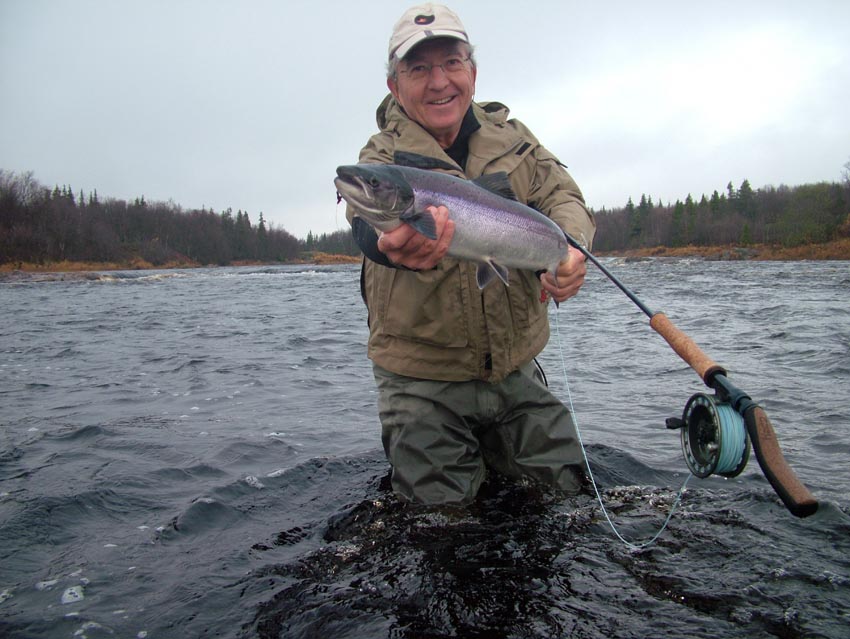
All caught in the first week of June salmons had  silvery color. These were fish in the 3 - 3.5 kg of weight. Some of them had a slight purple hue. Rarely seen salmon in the 4 kg weight. We expect the fresh fish of the sea, weighing up to 5 kg. Salmon are very actively resisted. Perhaps the strong current caused injury salmon during the struggle. Many salmon are bled when releasing the hook. Surely part of the fish have been released was killed.
   That was a lot of salmon, we caught no more than 4-6 hours a day. On average, each of us caught 10 to 20 pieces a day.
Water temperature is gradually increased and reached the end of the first week of June, 11 degrees. The water level is lowered daily. It was noticeable how salmon were overcome waterfall and go upstream.
With the change of water level in the river changed course and appeared and made available for new places for salmon fishing of the waterfalls.
At the mouth of the river quite often come across kelts Salmon, who also actively attacked the bait.
I came across a waterfall above the salmon smolts unusually large size. Fish were caught about 25 cm long. Perhaps it is a sign of the presence of very large adults. This is indirectly confirmed catches of salmon in August and September.


Sunday, 14 October 2012

Two BEST- two factors, the main rules in salmon fishing.


Two main Factors: fishing location and angler position

The river Chavanga surprises us from the very beginning of a season. Both September and October also have appeared successful for catching of a salmon. Periodic rains saved high enough water level in the river. The temperature fluctuated within 7-9 degrees. Fresh sea fish rose in the river every day. Therefore to catch it was comfortable. The  nearest to the sea site of the river has numerous and various places which are convenient for rest of a salmon and are convenient for its catching. For adaptation of fishers we use Cable Pool. It is the big and long turn of the river with coast convenient for movement and not strong current. Especially it is convenient for catching during a high water level.
Here   it is possible to use -2 BEST-  a principle of catching of a salmon that means to use the best place for a salmon and the best place for the fisher. If you are capable to find or define these two best places on the river,  your   chance of successful catching sharply raises. If you are capable independently or by  help of the guide to define the best place for parking or movement of a salmon and can take the best place that  allow you to fish this place correctly - then you the successful fisher. These two moments basically   define your success. Quality of tackle, casting quality   and subjective efficiency of a fly appear often on the second and third plan.
We face often that fishers cannot use the salmon tackle correctly. Often there are problems with  correct casting  and especially with presentation of a fly. In such cases the correct choice of a place of catching and a correct choice of a fisher position   defines success of fishing. The correct choice of a place sharply raises chance of a meeting of a salmon and a   fly, and the correct position levels many problems in casting quality   and especially in fly  presentation  .
If to speak about the most important in salmon catching - about presentation of a fly -  using  of  2BEST,   is often the most important moment in achievement of really correct presentation.