Showing posts with label Red Francis. Show all posts

Sunday, 13 December 2015

Correct speed of fly presentation.

I found   interesting   debate on the salmonfishingforum and I want to  share it with  you.

 http://www.salmonfishingforum.com/forums/thread123031-2.html


       Our NEW Chavanga web page and NEW Blog

                                    https://www.chavanga.com/   

                         https://www.chavanga.com/blog

Vasil Bykau


AMcD 
What is the correct speed?

Is there a correct speed when swinging flies for salmon?


This I am sure has been discussed a great deal on here, but with the "Depth" thread live, I just wanted to ask if the speed varies for time of year/conditions or should it be varied at all times?

In the spring, I am always trying to slow down a fly - makes sense in big cold water. However, on the Tweed a couple of weeks ago, we were trying to fish slow as well. It was biggish, perfect height i'd say, but not cold. Yet all the fish landed were caught stripping. A few fish were lost mid swing having taken yards of line (I have another theory on this fish). When I used to fish the Dee in September/October, most fish were caught stripping flies at all depths, the faster the better.

So is there a "correct" speed for a given situation, or should I be trying all speeds as I fish down a pool - which is what i try to do. Maybe I'm wasting my time?


I believe that if the depth is correct to present the fly in the taking window for given conditions and the fly size is correct for water clarity then there is no such thing as too fast provided the fly remains in the taking window for temperature and clarity. 

I use the example of all the fish taken on rapalas and spoons with their exaggerated actions. 
We're trying to illicit an aggression response not a feeding one so I believe movement is key.

Generally i like to fish big/long winged flies at speed(stripping or casting square and maybe even mending line in a down stream belly) and smaller flies a little slower,and when thats not working and i know theres fish in i will mix it all up till i find an answer or go home having tried it all 

I'm convinced you loose far more opportunities for salmon fishing too slow rather than too fast. I don't really do cold water stuff much so I'll leave that to those that do, but from late spring to late autumn, keep your flies moving at a fair lick. Salmon are predators and you don't want to give them too long to see what your using.

Mix it up big stylee! 


Indeed. He probably knows a thing of two about the game!

I wonder how he'd have got on fishing the Tweed or Nith this back end!!!!


IMHO depends on the lie, some respond to hanging a fly there and the salmon slams it after what seems an eternity, others seem to fish best to a big belly and a strip...That is the value of getting to know a bit of water well


Also I seem to find that the Findhorn and Spey like a faster fly than the Wye for example.


I'm not sure he would be easily persuaded to try.


Cold water fishing is definately a different job, and I have to say not my thing. I'm pretty sure slow not fast is going to be the go. I think around 11c is the point where they will take big falls, and that indicates it is the lowest temp for a "high speed" approach. I'm not sure how steep the downward curve is but I'd guess below 4 there not moving much. So I'd say 4 and below, as slow as you can, while you gently freeze, then speed up all the way to 11.
AMcD 

Thanks for all the responses. I agree with all of them! Slow when cold, fast when warmer and with big flies, and vary it... I like fishing long winged Scandi style flies - I really think these fish best fast. 


A note from experience - I do seem to catch more sea trout than any of my pals while fishing for salmon, stripping big flies. But I think i fish a fly faster than they do.


I think a great deal depends on the condition of the fish. I find that the fresh fish will likely take the fly fast, slow, across, down, whatever. If you have what are largely stale fish or at least reluctant takers, a fast cross current strip will often get one to take, and I've found that even in cool back-end conditions. 

In the summer when it gets really warm on the Miramichi very slow swings are more likely to be taken, dead-drifted dry flies even more so.
1.     
2.   

I'll be very honest here,what ever most Salmon flies represent to our quarry I have no true idea(I can guess sometimes),but one thing is quite obvious,whatever the water temp and current speed the size of the fly one uses has to be capable of moving at the speed one is presenting it at.

If I may illustrate,early Spring,lots of cold extra water,say a size 8 dressed flee in use,cast at the obligatory 45 deg. and left to fish in all honesty will be moving far too fast for most of the swing,it may well be that its not until its right into the slow water right in the edge that the flee looks natural.
A 1 1/2" tube cast slightly squarer and again left,will look un natural for the early part of the swing,then look spot on for the greater part of the swing, before looking un natural again when it gets into the edge.
A gurt big collie/monkey flee cast square will look ok almost straight off but all the while begin to loose its natural appeal the more it swings into ever slacker water.All the above is of course without any outside interference in the form of wading, mending or retrieve!.
So if we begin to think about the size of the flee,the angle of cast to slow or speed its path(wading bit comes in there),mending to slow it or retrieving to speed it we can increase a flee's effectiveness for a greater part of the swing!.
Of course,this is all a moot point as there's always things like depth to ruin everything,Salmon being Salmon and closely related to women will and often do completely unpredictable and very daft things!,then the worst of the lot is that you can't catch what isn't there!.
I tend to look at the area of the river I expect fish to be in and work out how my flee will arrive there and roughly what speed it will need to be swimming at to look attractive to our quarry,then I'll pick a size of flee I think appropriate and give it a good go!.
The Francis Grant book Salmon Fishing Dynamics explains it very well,but it will take some reading and practical experience to digest-its probably the best way to start,much better than my feeble attempts.
So if I assume a 1 1/2"tube in the early season will look ok for the greater part of my swing when utilised with wading,mending,angle of cast etc,then I'll give it a go.If I see fish or suspect they're there and get no joy,I could fish a bigger flee squarer so it comes through faster and retrieve ever faster towards the dangle,or fish the same big flee slower and deeper by a longer shallower downstream cast and wade deeper(if poss.)and hover the flee over the fish more.I could also fish the small size 8 flee at the 45 deg. angle and allow it to be swept over and downstream of the fish as though its being carried away by the current,until it eventually gets to the steadier water where it will look natural as its able to hold station or even swim against the current almost right in the edge.
As the water warms more throughout the year,the Salmons metabolism rises as does that of its prey,where you would have used a 1 1/2"tube you are now on the size 8 as it appears natural!,the bigger collie /monkey now looks un natural even cast square unless we impart a very very fast retrieve,we may even consider going smaller and fishing a tiny size 14 in the lowest summer flows and allowing it to hover in the creases and edges of the streams as it will look natural.
If you're sat there beaten,have a think and you can now play with the size of the flee and how you fish it going either side of the norm,either smaller or larger!,slower or faster
If fish are your side of the river you may well be able to present a flee nice n careful n slow in the small sizes,or go medium and add a retrieve,if they're on the far side,you could go medium sized,throw in a mend,allow the flee to fish and retrieve towards centre/your side,or fish larger/longer -cast squarer so it comes round faster and retrieve,but that presentation may well be sacrificial to your side as it will look totally out of order.
None of this drivel takes into account the depth you fish your flee-thats for another thread and my fingers are bleeding!- but maybe its a start,its how I look at things from the off.Its not an exact science,but an approach most use to start off their day,of course unless the Ghillies is there with a smile on his face saying its a dead cert if you do such n such!.The hardest step is the first choice of size-or reference-once you get a grip of that the understanding does follow!.Good luck and happy flee swinging!,

Pedro.


In my opinion the most important thing (obviously assuming there are actually salmon in the water you are fishing) is knowing your water. The better you know it the more rabbits you can pull from your hat. Cast well and get that fly PRECISELY placed and fully turned over and you are already ahead. 


Tons one can do to influence a fish with fly speed and depth. Some fish in some pools are more forgiving. Some are less. And in 15 minutes a new fish (or a stale one whose switch just flipped) may be there which is suicidal. 

YMMV....

Salmon season can't get here fast enough this coming year, dealing with SERIOUS withdrawals already. Going to be a long winter in these parts


There's so many variables in a river like flow speed, depth, rocks etc that is hard to give a definitive answer in mph. I find the most important thing is to keep in touch with the fly from the second it hits the water and give it life.

I always have the line in my hand throughout the swing feeling for information about what's happening at the point.
My retrieve speed can vary from zero to quite fast depending how I feel the fly is behaving at different points during the swing and I find a downstream mend will catch more fish than an upstream one.

So to try and put an answer in a nutshell, Give it Life

salmon fishing, Red Francis, pesca del salmon in Russia, peche au saumon Russie, Pêche au saumon atlantique, 


Friday, 4 April 2014

Spring salmon fishing on the rivers of Kola Peninsula.


Part 1

Salmon season  on rivers Chavanga, Strelna and Varzuga begins in May. This period is characterized by high water levels in rivers, cold water and big quantity  of fish. With the increase of water temperature of 6-8 C   salmon becomes active and reacts to artificial flies. Therefore, for many anglers last May - first June weeks are the best start to the season.

The problem is that spring comes every time another. Therefore, the situation on the river almost never repeated. Keep in mind that the simplest combination of temperature and water level is complicated because we have to take into account a host of other factors. One of the most important is the dynamics of these factors. For example, the high temperature of 18-20 degrees is not a threat to the activity of the fish. But if the temperature is increased in a few days, then it will lead to a significant decrease in activity.
This is the case in the spring, a sharp change in transparency, water level and temperature decreases   fish activity. A very important factor is the state of the rivers in the winter. Especially dangerous are  hard frost  and  freezing of the  rivers. Drastically reduces the number of suitable sites for salmon. A considerable part of the fish may die under the ice.. The transition from winter to spring is often strongly influenced on    spring fishing. The rapid melting of snow and ice leads to a very intense lifting and movement of water and  ice. Traffic jams of ice, which is deprived of the salmon sites. Part of the fish is killed by  stormy spring break.

For these reasons, the behavior of salmon in the new season may significantly differ from the picture that we remember from last year. The fish can be different in temperament, others positions  in the river, and a completely different reaction to our flies. Therefore, our last year's technique, fly, which we had placed so much hope, work is not as good as last year. Every year we have to try to understand what has changed in the river, what factors were decisive for the behavior of salmon. Then we have a chance to choose the right tactics for fishing, identify promising places to find the best equipment and gear.


  Part 2


The main problem that we face in the spring - is a high water level. In a large volume of water is difficult to navigate and find parking salmon. The river changes its nature, salmon chooses way to go up the river and places to stay  that are not obvious to us  .  Most often we have to use tackles  that   can bring  our  fly closer to the bottom. Here there are four choices,1.  use a heavy line (leader) and a heavy fly -.2.  use only   heavy line,3.  use a heavy fly on a floating line 4.  and use special techniques presentations that allow you to omit the fly sink. The correct choice between these options or the right combination determines the success of catching salmon. Given my own experience, I would suggest using a normal fly on a sinking line for use in such areas of the river where we can not confidently know   where salmons are staying.  . In this case, we have to present the fly over a wide area. This option is suitable for fishing on the broad reach, it allows you to quickly test a large area. Sometimes we find a good place in which salmon attack one after the other. With high water levels cause accumulation of fish in a certain place is not clear to us. But in the summer, we often find in this place - for example - a few individual stones that served as a hiding place for salmon in the spring.  If we know in advance about the existence of such anomalies at the bottom, we can greatly narrow down your search and do not waste time fishing in unpromising places of the river. This is the right place to apply the floating line  and heavy flies. Floating line  facilitates casting and management of fly, and weight allows it to fly down towards the bottom. In this situation, we do not need to check   large area, we can focus on fishing in a particular location. If we can apply the casting upstream or casting slack line, we will be able to   deep  the fly to the desired location. Mending of varying intensity is very useful  to achieve the same goal. If you use the   upstream  mending  - fly reduces the speed downstream and an added opportunity to dive deeper. If we do Mending downstream, we make fly to move  across with increasing speed. This technique can cause salmon, but more often it is suitable for the first version, in which we have to handle a large area.


Part 3.

  High and cold water, season beginning, end of May – early June.

Location 1

Fishing at the  very deep places , large depth, big volume of the water,  the main stream, under rapids holes , deep plum.
Bottom  fishing by fast sinking line and large  heavy flies.
Flies -  2-inch copper tubes, Waddington and other heavy body, wing length  up to 10-12cm.
Colors are mostly bright, contrast, in the wing of a combination of red, yellow, black with bright elements on the body flies.

Location 2
  Slow, not a very deep pools, clamps along the river, small holes where salmon stays for rest.
Fishing near   the bottom,  sinking line  and flies   0.75-1.5 inch brass tubes, Waddington and other bodies  are not very heavy, wing length up to 8 cm.
Bright enough,   wing -  combination of red, yellow, green, black.


The very beginning of the summer, the water is still high and cold, but becomes brighter and the level falls.  First weeks of June.

Location 1
The same  deep places , large depth,   bottom  fishing by fast sinking line  at the main stream, under rapids holes , deep plum.
Flies -  0.75-1.5 inch copper tubes, Waddington and other major carriers, wing length up to 8 cm.
Bright enough,   wing -  combination of red, yellow, green, blue, black with bright elements on the body flies.

Location 2
  Slow, not a very deep pools, clamps along the river, small holes, fishing near   the bottom,  sinking line.  
Flies   0.75-1-inch brass tube, Waddington and others not the heavy  carriers  and single hooks № 2-4, wing length up to  6 cm.
The wing is dark, but with bright elements, too bright elements on the body flies.


Summer takes effect, light and water drops, warm up to 10-12 degrees.

Location 1
Deep places near the main stream,  large depth,  under rapids holes , deep plum,   means bottom  fishing by fast sinking line.   
Flies   0.5-1-inch brass tube, Waddington and others carriers,  double and single hooks № 2-4-6, wing length  5 cm.
The wing is mostly dark and bright elements on the body flies.

Location 2
In a  slow, not deep water we use  undersurface  fly on a intermediate line.   
Flies   0.5-0.75 inch brass or aluminum tubes and other light carriers, single and double hooks № 4-6, wing length and 5 cm .Wing dark, bright elements on the body flies.


Friday, 15 March 2013

July salmon fishing. Strelna river.


In the middle of summer, in July, most of the Strelna river  salmons go  above waterfalls, climbs into the open stretches and small rapids. In the lower part of the river are the fish who have found shelter under the threshold and in the depth of the pits by the waterfalls. At this time  fresh   salmon goes up  from sea. They can be caught in the lower areas near the estuary of the river. But upstream salmon trying to go faster, higher and further upstream. For 6-8 kilometers up from the camp we can  found fish in the deep reaches of the pit and the rocks. In such places, accumulated a significant amount of fish. Here you can watch a mixture of salmon that were in the river throughout the season, here  are the brown giants from last fall and fresh summer silver salmons in the company of small grils.


The photographs show how the river Strelna changes. Here are no   rocks and waterfalls, the river is located in a wide valley.
I am sincerely grateful to Patrick for    great photos!


atlantic salmon, peche au saumon Russie, pesa peninsola di Kola, pesca a mosca, Pêche au saumon atlantique, pêche à la mouche, Red Francis, salmon fishing in Russia, salmone atlantico, voyage peche


Friday, 14 September 2012

Strelna river fresh salmon.


                                  Salmon fishing in Russia. Strelna river. May-June 2012.


The end of May and the beginning of June consider many as the most interesting time for catching of a salmon. It is possible to agree with these fishers. In the river it is a lot of fish, it is active and willingly reacts to baits. Still there are no mosquitoes and a catching condition are comfortable enough. There is one factor which should be considered at fishing planning. It is level of spring water in the river.


Little bit violet silver resident Strelna estuary salmon


Fresh sea salmon

Several rocks not far from Strelna estuary 

But a spring river condition  is    very difficultly to predict. Therefore as more reliable are considered last week May and the beginning of June. In this season the water level in the Strelna  river was comfortable, water temperature made 10-11 degrees. The water level in the river gradually decreased.   The Strelna falls braked lifting of fish upwards on the river. All places where fishes could have a rest, have been filled by a salmon.


 The salmon actively reacted to a fly. To my astonishment  Shrimp fly was allocated with nothing, and   same atractor, but with a black wing is better. It seemed to me that fly in style Red Frencis well worked. At least, salmons instantly reacted to its occurrence. When I have lost last - then it was necessary to think of other variant.  6-8 doubles Nothern Autumn fly  of my collection worked well. Though the size of a fly did not play  a special role  . It was more important to submit a fly more close to a bottom. In places with a water rapid current took out a bait on a surface. Double hand rods are very useful. One or two meters of rod length give us more variants to correct line and fly position. Especially when we used  sinking lines  and leaders. Sometimes we  practised casts upstream to give some seconds on fly immersing.


Catching among Strelna falls and rocks is interesting enough and difficult. It is necessary to be able to operate a line on a powerful current. Catching in a river mouth has appeared quieter and convenient. The large quantity of fish came with inflow into a Strelna river mouth. The average size of fishes has made 3-3.5 kg. There were  fresh sea fish, silver one that  stays in estuary during winter-spring and silver kelt, going back to the White sea. 


  Nothern Autumn fly after the  next landed fish.


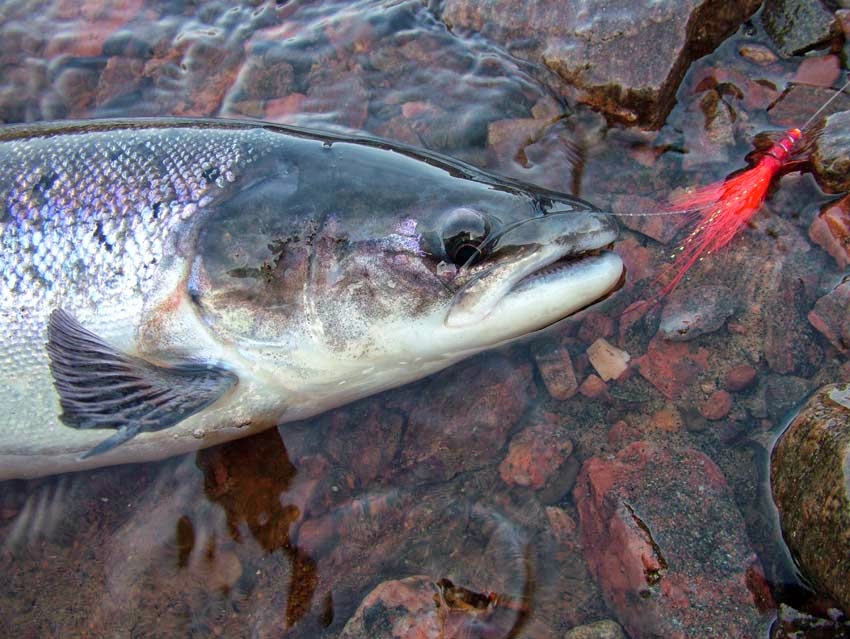
 Frencis fly - especially good  for fresh and nervous fish.


 Probably, such abundance has also a negative side. I was quickly enough tired with such catching. It has seemed to me enough the monotonous. In my opinion, catching on small water in the middle of a season is not so productive, but is more interesting and is fascinating.   


Strelna river estuary during low tide.


atlantic salmon, voyage peche, salmon fishing in Russia, salmone atlantico, pêche à la mouche, Pêche au saumon atlantique, Red Francis, pesca a mosca, pesa peninsola di Kola, peche au saumon Russie, Strelna river.