Our NEW Chavanga web page and NEW Blog
I found an article by Paddy McDonnell about the tactics of salmon fishing in cold water. The article seems to me very interesting. I just want to add that every river and every season has its own peculiarities, and we just need to make adjustments in the tactics of catching and take into account the specific situation.
You can click on the link and see the original or read it here.
Or you can look at the forum
COLD WATER SALMON TACTICS
Paddy McDonnell
One of the most highly prized achievements in angling is to land a fresh
spring salmon, and to accomplish this in the cold water conditions of early
season is probably one of the most gratifying achievements of all. Some anglers
associate early spring salmon fishing in cold water with the months of January,
February, and the first half of March, but quiet often we can get severe cold
snaps right through April also.
You must fish a big fly slow and deep when the water is cold in
springtime.This statement has been handed down from father to son/daughter over
many generations and is part of the lore of salmon fishing. Thousands of
anglers over the generations have found this is the best approach, are they
right? Today we have many advantages in terms of better fishing tackle etc, so
are there any modern tactic’s that can replace the advice given above? How deep
is deep? How slow is slow? and what size is a big fly?.
When an experienced angler or ghillie passes on some advice to help solve a
particular fishing problem the recipient must trust that it is based on
personal practical experience. Better still if the advice can be supported in
some way by any relevant scientific studies, then the angler can fish with the
extra confidence, and persistence that is so vital when searching for that
elusive early Springer in cold water conditions.
Luckily for us the effects of water temperature on salmon behaviour have
been studied by MH Beach in the early 1980s, and some of the results were
published in the early 1990s by the Scottish Fisheries Department in their
document – Notes for Guidance on the Provision of fish passes and screens for
the safe passage of salmon.

When constructing fish passes it is important to understand the swimming,
and leaping ability of salmon so as to provide safe passage for them through
the system. There were two types of speed noted in the study ‘cruising’ which
can be maintained easily for long periods, and ‘burst’ which gives the salmon
the extra thrust to swim at high speed when needed, and can be only maintained
for short periods of time. The study showed that large salmon could swim faster
than small salmon, and that water temperature affected swimming speed. Colder
water = slower maximum speed. A graph was produced to show maximum
swimming speeds in relation to fish size over temperatures ranging from 2-25
degrees Centigrade At 5 degrees C a 6lb salmon had a predicted maximum speed of
2.6 meters per second, the same fish swimming in water at 10 degrees C had a
maximum speed of 3.7 meters per second, and when swimming in water at 15
degrees C its maximum speed increased further to 4.7 meters per second.
The graph for a 20lb salmon was 3.3 meters per second at 5C, 4.7 meters per
second at 10C, and a staggering 6 meters per second maximum speed at
15Centigrade.

Through trial, error, and practical experience (when all is said and done
there is no substitute for practical experience) our forefathers had it right
about fishing slow and deep in cold water for salmon. The study also supported
the observations made by previous generations about the reluctance of salmon to
negotiate stretches of rapids or waterfalls in cold water conditions, with the
fish normally waiting to run until the water temperature reached at least 5-6
degrees C. With their maximum swimming speed severely restricted in water of 4
degrees C or less the salmon have little choice but to wait. These rapids or
waterfalls became known as temperature barriers, and the pools where the salmon
rested waiting for the water to warm up became known as temperature pools.
When choosing which salmon fly to use in any given situation we must
consider what it is we are trying to achieve. The first objective is to create
a reasonable impression of a living, vulnerable prey item which will have an
impact on the fish. The second consideration might be the profile of the fly,
slim tubes, and hair wings suit fast currents whereas Irish shrimps are best
used in moderate to slow currents. In fast water the salmon gets less time to
see the fly so you might choose a bigger fly, and conversely in slower water a
smaller fly might be enough to create the illusion of life, and guard against
creating too strong of an impression, or impact thus maintaining the holy grail
which in my opinion is a fly that is visible, and vague at the same time!.
There are other considerations also, such as in coloured water we might use
more colourful flies, in slow currents we might consider flies tied with extra
soft mobile materials, as they will be hovering close to the fish for longer,
and this may help in the deception. The main reason big(and sometimes
colourful) flies are successful for salmon in cold water is the strong impact
they have on the fish whose metabolism has slowed way down with their senses
dulled slightly and this is what it sometimes takes to wake them up. Yellow
(especially fluorescent yellow) is a great colour in cold water, and is the
dominant colour in many of the great traditional, and modern cold water salmon
flies. One of my favourites is the gold Willie Gunn, tied with proportionally
extra yellow hair for coloured water, equal amounts of yellow, orange, and
black hair for normal conditions. For clear water I like a standard Willie Gunn
(black body, gold rib) tied with more black hair than yellow, and orange.

Every spring salmon river system has its own local favourite flies, and it
is usually wise to include them in your armoury, just make sure you have them
in large enough sizes for cold water fishing. Big flies in my opinion start at
about 2inches overall measurement up to about 6inches with 3-4inchs being the
most commonly used sizes, and there are some anglers who occasionally use flies
(usually sunray shadow’s) of 8-10inches long. Three or four favourite patterns
in different sizes tied on plastic, aluminium, and brass tubes are usually
enough to take with you as cold water spring salmon fishing is not the place to
be experimenting with variants of established patterns, because when the going
gets tough doubts creep in, confidence flags, much better to stick with proven
original patterns that have stood the test of time.
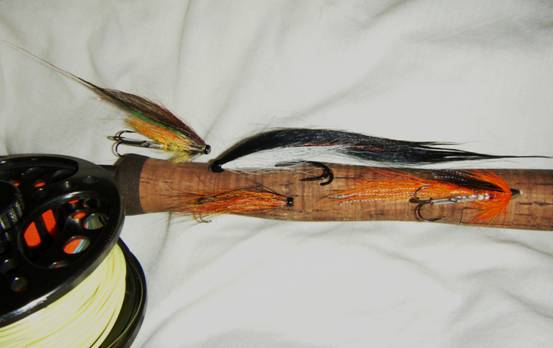
Some of my favourite cold water salmon flies, A 2 inch Gold Willie Gun, A 3
inch Silver Grey, A 4 inch Cascade, and a 6 inch Sunray Shadow, all on tubes

Lethargic cold water salmon need the fly to be put in their face to wake
them up, and this means swimming it at1-2 ft from the river bed. Regardless of
skill level when we fish this close to the bottom there are going to be flies
hung up and lost, in fact if we fish the whole day without hanging up, and
losing the occasional fly then we are probably not fishing deep enough. We use
various sinking fly lines to get down, and swim our fly close to the fish with
a balance to be struck between choosing a line that sinks too much constantly
snagging bottom, a line that never snags at all presenting our fly too far
above the fish, or the best compromise, a line that causes our fly to tick
bottom regularly enough to make us feel confident that we are bumping them on
the nose. Nowadays we are spoilt for choice with the range of different
sink rate fly lines available to us. There are full sinking lines, and wide
choice of density compensated, or sink tip lines which should help us cope with
most situations. Type 2, 3, and 4(inches per second) sinking lines are probably
the most useful, but its no harm to have an even faster sinking line with you
to cover all eventualities. I prefer to use lightweight flies with my sinking
line as they retain their lifelike appearance even in slow currents, but if my
fastest sinking line isn’t getting deep enough then I will use one of my brass
tubes to reach the taking zone. Leader lengths can vary from 3 ft for the
deepest presentations, up to 6-8ft for clear water situations. Monofilament
breaking strains of 20lb, or more should be the norm as our leaders will be in
contact with the river bed and rocks many times during the day. Every time we
snag up on rocks, or whatever, it would be wise to check for any signs of
abrasion, and replace the leader if in any doubt.

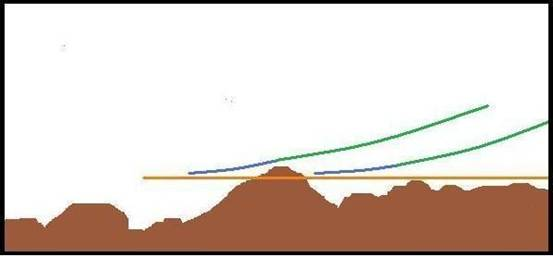
Sometimes when fishing deep in very rocky pools a full sinking line can get
hung up a lot, because it tracks relatively flat as depicted by the orange line
in the diagram above. If we use a sink tip line instead as depicted by the
blue/green line, we may dodge some of the snags as we work our way down the
pool.

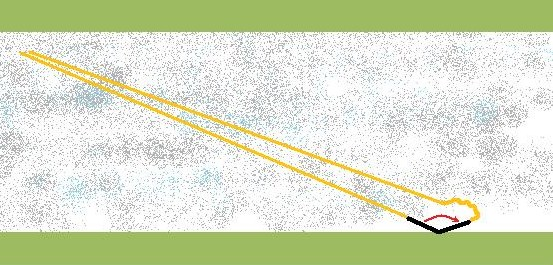
In cold water the salmon’s metabolism slows down so we fish our flies as slowly
as possible. The more of an angle we cast down and across the river the slower
the fly will come around, however if we need to get extra depth (especially on
the far side of the river) we can make a reach mend upstream after we make our
cast, and as our fly line is unrolling out in the air over the river, as
depicted in the diagram above. Another wrinkle to add to this is to have some
spare loops of line retained after the reach mend so we can roll or shake out
extra slack to achieve even more sink time before the current starts to tighten
up, and fish our fly across. If that’s not enough we can always take a step
downstream as well!!
Salmon taking the fly in cold water often take so gently that its as if
they just slowly grow on the end of the line, and as the slow deep throbs grow
stronger we immediately seem to forget all those fishless hours, and aching
cold limbs. Some experienced anglers just clamp the line on the rod cork, and
wait until everything tightens up before lifting into the fish; others set the
drag on their fly reels on a light tension (just enough tension that it doesn’t
overrun) and allow the fish to take a couple of yards of line of the reel
before lifting to set the hook, either method is good.

In cold weather the middle part of the day is usually best as whatever sun
maybe shining will have had time to hopefully raise the water temperature a
little, and encourage the fish to take. Anglers who regularly catch spring
salmon on the fly especially in cold water conditions, are not just lucky, they
consistently present their flies accurately in difficult conditions, and
persist when others have thrown in the towel. Later on when the water
warms up, and reaches temperatures of 6-12C, the salmon will be invigorated as
this is the temperature band which suits them best, allowing them to once again
reach maximum speed and reclaim their glorious title. Salmo salar -The leaper
Kola Peninsula salmon tours, fang von lachs in Russland, pêche à la mouche, salmon fishing in Russia,