Wednesday, 16 December 2015

Cold water salmon fishing


       Our NEW Chavanga web page and NEW Blog

                                    https://www.chavanga.com/   

                         https://www.chavanga.com/blog

Vasil Bykau

 I found an article  by Paddy McDonnell   about the tactics of  salmon fishing in cold water. The article seems to me very interesting. I just want to add that every river and every season has its own peculiarities, and we just need to make adjustments in the tactics of catching and take into account the specific situation.


 You can click on the link and see the original or read it here.


Or you can look at the forum 


                    COLD WATER SALMON TACTICS

Paddy McDonnell 
One of the most highly prized achievements in angling is to land a fresh spring salmon, and to accomplish this in the cold water conditions of early season is probably one of the most gratifying achievements of all. Some anglers associate early spring salmon fishing in cold water with the months of January, February, and the first half of March, but quiet often we can get severe cold snaps right through April also.
You must fish a big fly slow and deep when the water is cold in springtime.This statement has been handed down from father to son/daughter over many generations and is part of the lore of salmon fishing. Thousands of anglers over the generations have found this is the best approach, are they right? Today we have many advantages in terms of better fishing tackle etc, so are there any modern tactic’s that can replace the advice given above? How deep is deep? How slow is slow? and what size is a big fly?.
When an experienced angler or ghillie passes on some advice to help solve a particular fishing problem the recipient must trust that it is based on personal practical experience. Better still if the advice can be supported in some way by any relevant scientific studies, then the angler can fish with the extra confidence, and persistence that is so vital when searching for that elusive early Springer in cold water conditions.
Luckily for us the effects of water temperature on salmon behaviour have been studied by MH Beach in the early 1980s, and some of the results were published in the early 1990s by the Scottish Fisheries Department in their document – Notes for Guidance on the Provision of fish passes and screens for the safe passage of salmon.

When constructing fish passes it is important to understand the swimming, and leaping ability of salmon so as to provide safe passage for them through the system. There were two types of speed noted in the study ‘cruising’ which can be maintained easily for long periods, and ‘burst’ which gives the salmon the extra thrust to swim at high speed when needed, and can be only maintained for short periods of time. The study showed that large salmon could swim faster than small salmon, and that water temperature affected swimming speed. Colder water = slower maximum speed.  A graph was produced to show maximum swimming speeds in relation to fish size over temperatures ranging from 2-25 degrees Centigrade At 5 degrees C a 6lb salmon had a predicted maximum speed of 2.6 meters per second, the same fish swimming in water at 10 degrees C had a maximum speed of 3.7 meters per second, and when swimming in water at 15 degrees C its maximum speed increased further to 4.7 meters per second.  The graph for a 20lb salmon was 3.3 meters per second at 5C, 4.7 meters per second at 10C, and a staggering 6 meters per second maximum speed at 15Centigrade.
Through trial, error, and practical experience (when all is said and done there is no substitute for practical experience) our forefathers had it right about fishing slow and deep in cold water for salmon. The study also supported the observations made by previous generations about the reluctance of salmon to negotiate stretches of rapids or waterfalls in cold water conditions, with the fish normally waiting to run until the water temperature reached at least 5-6 degrees C. With their maximum swimming speed severely restricted in water of 4 degrees C or less the salmon have little choice but to wait. These rapids or waterfalls became known as temperature barriers, and the pools where the salmon rested waiting for the water to warm up became known as temperature pools.
When choosing which salmon fly to use in any given situation we must consider what it is we are trying to achieve. The first objective is to create a reasonable impression of a living, vulnerable prey item which will have an impact on the fish. The second consideration might be the profile of the fly, slim tubes, and hair wings suit fast currents whereas Irish shrimps are best used in moderate to slow currents. In fast water the salmon gets less time to see the fly so you might choose a bigger fly, and conversely in slower water a smaller fly might be enough to create the illusion of life, and guard against creating too strong of an impression, or impact thus maintaining the holy grail which in my opinion is a fly that is visible, and vague at the same time!. There are other considerations also, such as in coloured water we might use more colourful flies, in slow currents we might consider flies tied with extra soft mobile materials, as they will be hovering close to the fish for longer, and this may help in the deception. The main reason big(and sometimes colourful) flies are successful for salmon in cold water is the strong impact they have on the fish whose metabolism has slowed way down with their senses dulled slightly and this is what it sometimes takes to wake them up. Yellow (especially fluorescent yellow) is a great colour in cold water, and is the dominant colour in many of the great traditional, and modern cold water salmon flies. One of my favourites is the gold Willie Gunn, tied with proportionally extra yellow hair for coloured water, equal amounts of yellow, orange, and black hair for normal conditions. For clear water I like a standard Willie Gunn (black body, gold rib) tied with more black hair than yellow, and orange.

Every spring salmon river system has its own local favourite flies, and it is usually wise to include them in your armoury, just make sure you have them in large enough sizes for cold water fishing. Big flies in my opinion start at about 2inches overall measurement up to about 6inches with 3-4inchs being the most commonly used sizes, and there are some anglers who occasionally use flies (usually sunray shadow’s) of 8-10inches long. Three or four favourite patterns in different sizes tied on plastic, aluminium, and brass tubes are usually enough to take with you as cold water spring salmon fishing is not the place to be experimenting with variants of established patterns, because when the going gets tough doubts creep in, confidence flags, much better to stick with proven original patterns that have stood the test of time.
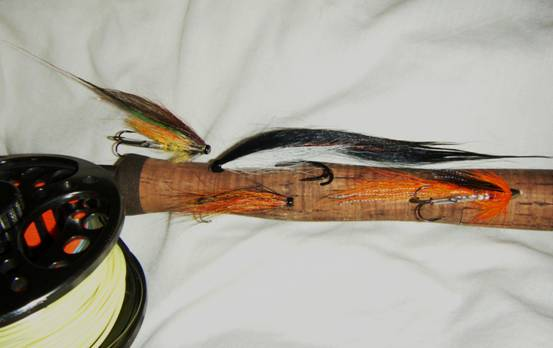
Some of my favourite cold water salmon flies, A 2 inch Gold Willie Gun, A 3 inch Silver Grey, A 4 inch Cascade, and a 6 inch Sunray Shadow, all on tubes


Lethargic cold water salmon need the fly to be put in their face to wake them up, and this means swimming it at1-2 ft from the river bed. Regardless of skill level when we fish this close to the bottom there are going to be flies hung up and lost, in fact if we fish the whole day without hanging up, and losing the occasional fly then we are probably not fishing deep enough. We use various sinking fly lines to get down, and swim our fly close to the fish with a balance to be struck between choosing a line that sinks too much constantly snagging bottom, a line that never snags at all presenting our fly too far above the fish, or the best compromise, a line that causes our fly to tick bottom regularly enough to make us feel confident that we are bumping them on the nose.  Nowadays we are spoilt for choice with the range of different sink rate fly lines available to us. There are full sinking lines, and wide choice of density compensated, or sink tip lines which should help us cope with most situations. Type 2, 3, and 4(inches per second) sinking lines are probably the most useful, but its no harm to have an even faster sinking line with you to cover all eventualities. I prefer to use lightweight flies with my sinking line as they retain their lifelike appearance even in slow currents, but if my fastest sinking line isn’t getting deep enough then I will use one of my brass tubes to reach the taking zone.  Leader lengths can vary from 3 ft for the deepest presentations, up to 6-8ft for clear water situations. Monofilament breaking strains of 20lb, or more should be the norm as our leaders will be in contact with the river bed and rocks many times during the day. Every time we snag up on rocks, or whatever, it would be wise to check for any signs of abrasion, and replace the leader if in any doubt.
Sink tip v Full sink line
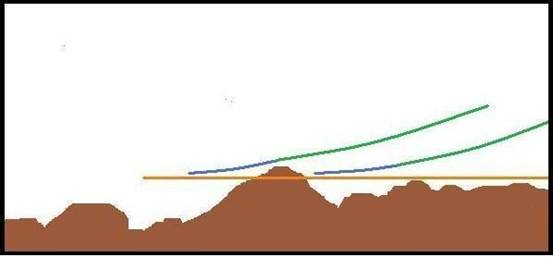
Sometimes when fishing deep in very rocky pools a full sinking line can get hung up a lot, because it tracks relatively flat as depicted by the orange line in the diagram above. If we use a sink tip line instead as depicted by the blue/green line, we may dodge some of the snags as we work our way down the pool.
Aerial mend
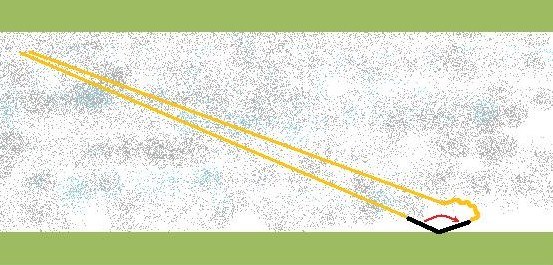
In cold water the salmon’s metabolism slows down so we fish our flies as slowly as possible. The more of an angle we cast down and across the river the slower the fly will come around, however if we need to get extra depth (especially on the far side of the river) we can make a reach mend upstream after we make our cast, and as our fly line is unrolling out in the air over the river, as depicted in the diagram above. Another wrinkle to add to this is to have some spare loops of line retained after the reach mend so we can roll or shake out extra slack to achieve even more sink time before the current starts to tighten up, and fish our fly across. If that’s not enough we can always take a step downstream as well!!         
Salmon taking the fly in cold water often take so gently that its as if they just slowly grow on the end of the line, and as the slow deep throbs grow stronger we immediately seem to forget all those fishless hours, and aching cold limbs. Some experienced anglers just clamp the line on the rod cork, and wait until everything tightens up before lifting into the fish; others set the drag on their fly reels on a light tension (just enough tension that it doesn’t overrun) and allow the fish to take a couple of yards of line of the reel before lifting to set the hook, either method is good.

In cold weather the middle part of the day is usually best as whatever sun maybe shining will have had time to hopefully raise the water temperature a little, and encourage the fish to take. Anglers who regularly catch spring salmon on the fly especially in cold water conditions, are not just lucky, they consistently present their flies accurately in difficult conditions, and persist when others have thrown in the towel.  Later on when the water warms up, and reaches temperatures of 6-12C, the salmon will be invigorated as this is the temperature band which suits them best, allowing them to once again reach maximum speed and reclaim their glorious title. Salmo salar -The leaper


Kola Peninsula salmon tours, fang von lachs in Russland, pêche à la mouche, salmon fishing in Russia, 

Sunday, 13 December 2015

Correct speed of fly presentation.

I found   interesting   debate on the salmonfishingforum and I want to  share it with  you.

 http://www.salmonfishingforum.com/forums/thread123031-2.html


       Our NEW Chavanga web page and NEW Blog

                                    https://www.chavanga.com/   

                         https://www.chavanga.com/blog

Vasil Bykau


AMcD 
What is the correct speed?

Is there a correct speed when swinging flies for salmon?


This I am sure has been discussed a great deal on here, but with the "Depth" thread live, I just wanted to ask if the speed varies for time of year/conditions or should it be varied at all times?

In the spring, I am always trying to slow down a fly - makes sense in big cold water. However, on the Tweed a couple of weeks ago, we were trying to fish slow as well. It was biggish, perfect height i'd say, but not cold. Yet all the fish landed were caught stripping. A few fish were lost mid swing having taken yards of line (I have another theory on this fish). When I used to fish the Dee in September/October, most fish were caught stripping flies at all depths, the faster the better.

So is there a "correct" speed for a given situation, or should I be trying all speeds as I fish down a pool - which is what i try to do. Maybe I'm wasting my time?


I believe that if the depth is correct to present the fly in the taking window for given conditions and the fly size is correct for water clarity then there is no such thing as too fast provided the fly remains in the taking window for temperature and clarity. 

I use the example of all the fish taken on rapalas and spoons with their exaggerated actions. 
We're trying to illicit an aggression response not a feeding one so I believe movement is key.

Generally i like to fish big/long winged flies at speed(stripping or casting square and maybe even mending line in a down stream belly) and smaller flies a little slower,and when thats not working and i know theres fish in i will mix it all up till i find an answer or go home having tried it all 

I'm convinced you loose far more opportunities for salmon fishing too slow rather than too fast. I don't really do cold water stuff much so I'll leave that to those that do, but from late spring to late autumn, keep your flies moving at a fair lick. Salmon are predators and you don't want to give them too long to see what your using.

Mix it up big stylee! 


Indeed. He probably knows a thing of two about the game!

I wonder how he'd have got on fishing the Tweed or Nith this back end!!!!


IMHO depends on the lie, some respond to hanging a fly there and the salmon slams it after what seems an eternity, others seem to fish best to a big belly and a strip...That is the value of getting to know a bit of water well


Also I seem to find that the Findhorn and Spey like a faster fly than the Wye for example.


I'm not sure he would be easily persuaded to try.


Cold water fishing is definately a different job, and I have to say not my thing. I'm pretty sure slow not fast is going to be the go. I think around 11c is the point where they will take big falls, and that indicates it is the lowest temp for a "high speed" approach. I'm not sure how steep the downward curve is but I'd guess below 4 there not moving much. So I'd say 4 and below, as slow as you can, while you gently freeze, then speed up all the way to 11.
AMcD 

Thanks for all the responses. I agree with all of them! Slow when cold, fast when warmer and with big flies, and vary it... I like fishing long winged Scandi style flies - I really think these fish best fast. 


A note from experience - I do seem to catch more sea trout than any of my pals while fishing for salmon, stripping big flies. But I think i fish a fly faster than they do.


I think a great deal depends on the condition of the fish. I find that the fresh fish will likely take the fly fast, slow, across, down, whatever. If you have what are largely stale fish or at least reluctant takers, a fast cross current strip will often get one to take, and I've found that even in cool back-end conditions. 

In the summer when it gets really warm on the Miramichi very slow swings are more likely to be taken, dead-drifted dry flies even more so.
1.     
2.   

I'll be very honest here,what ever most Salmon flies represent to our quarry I have no true idea(I can guess sometimes),but one thing is quite obvious,whatever the water temp and current speed the size of the fly one uses has to be capable of moving at the speed one is presenting it at.

If I may illustrate,early Spring,lots of cold extra water,say a size 8 dressed flee in use,cast at the obligatory 45 deg. and left to fish in all honesty will be moving far too fast for most of the swing,it may well be that its not until its right into the slow water right in the edge that the flee looks natural.
A 1 1/2" tube cast slightly squarer and again left,will look un natural for the early part of the swing,then look spot on for the greater part of the swing, before looking un natural again when it gets into the edge.
A gurt big collie/monkey flee cast square will look ok almost straight off but all the while begin to loose its natural appeal the more it swings into ever slacker water.All the above is of course without any outside interference in the form of wading, mending or retrieve!.
So if we begin to think about the size of the flee,the angle of cast to slow or speed its path(wading bit comes in there),mending to slow it or retrieving to speed it we can increase a flee's effectiveness for a greater part of the swing!.
Of course,this is all a moot point as there's always things like depth to ruin everything,Salmon being Salmon and closely related to women will and often do completely unpredictable and very daft things!,then the worst of the lot is that you can't catch what isn't there!.
I tend to look at the area of the river I expect fish to be in and work out how my flee will arrive there and roughly what speed it will need to be swimming at to look attractive to our quarry,then I'll pick a size of flee I think appropriate and give it a good go!.
The Francis Grant book Salmon Fishing Dynamics explains it very well,but it will take some reading and practical experience to digest-its probably the best way to start,much better than my feeble attempts.
So if I assume a 1 1/2"tube in the early season will look ok for the greater part of my swing when utilised with wading,mending,angle of cast etc,then I'll give it a go.If I see fish or suspect they're there and get no joy,I could fish a bigger flee squarer so it comes through faster and retrieve ever faster towards the dangle,or fish the same big flee slower and deeper by a longer shallower downstream cast and wade deeper(if poss.)and hover the flee over the fish more.I could also fish the small size 8 flee at the 45 deg. angle and allow it to be swept over and downstream of the fish as though its being carried away by the current,until it eventually gets to the steadier water where it will look natural as its able to hold station or even swim against the current almost right in the edge.
As the water warms more throughout the year,the Salmons metabolism rises as does that of its prey,where you would have used a 1 1/2"tube you are now on the size 8 as it appears natural!,the bigger collie /monkey now looks un natural even cast square unless we impart a very very fast retrieve,we may even consider going smaller and fishing a tiny size 14 in the lowest summer flows and allowing it to hover in the creases and edges of the streams as it will look natural.
If you're sat there beaten,have a think and you can now play with the size of the flee and how you fish it going either side of the norm,either smaller or larger!,slower or faster
If fish are your side of the river you may well be able to present a flee nice n careful n slow in the small sizes,or go medium and add a retrieve,if they're on the far side,you could go medium sized,throw in a mend,allow the flee to fish and retrieve towards centre/your side,or fish larger/longer -cast squarer so it comes round faster and retrieve,but that presentation may well be sacrificial to your side as it will look totally out of order.
None of this drivel takes into account the depth you fish your flee-thats for another thread and my fingers are bleeding!- but maybe its a start,its how I look at things from the off.Its not an exact science,but an approach most use to start off their day,of course unless the Ghillies is there with a smile on his face saying its a dead cert if you do such n such!.The hardest step is the first choice of size-or reference-once you get a grip of that the understanding does follow!.Good luck and happy flee swinging!,

Pedro.


In my opinion the most important thing (obviously assuming there are actually salmon in the water you are fishing) is knowing your water. The better you know it the more rabbits you can pull from your hat. Cast well and get that fly PRECISELY placed and fully turned over and you are already ahead. 


Tons one can do to influence a fish with fly speed and depth. Some fish in some pools are more forgiving. Some are less. And in 15 minutes a new fish (or a stale one whose switch just flipped) may be there which is suicidal. 

YMMV....

Salmon season can't get here fast enough this coming year, dealing with SERIOUS withdrawals already. Going to be a long winter in these parts


There's so many variables in a river like flow speed, depth, rocks etc that is hard to give a definitive answer in mph. I find the most important thing is to keep in touch with the fly from the second it hits the water and give it life.

I always have the line in my hand throughout the swing feeling for information about what's happening at the point.
My retrieve speed can vary from zero to quite fast depending how I feel the fly is behaving at different points during the swing and I find a downstream mend will catch more fish than an upstream one.

So to try and put an answer in a nutshell, Give it Life

salmon fishing, Red Francis, pesca del salmon in Russia, peche au saumon Russie, Pêche au saumon atlantique, 


Tuesday, 3 November 2015

Fishing on the Icha river, a brief overview of its potential.


       Our NEW Chavanga web page and NEW Blog

                                    https://www.chavanga.com/   

                         https://www.chavanga.com/blog

Vasil Bykau


Fishing on the Icha river, a brief overview of its potential.


    The concepts of "beautiful" or "good" river quite subjective. Typically, we put in them different meanings, but there are common points such as untouched, beautiful landscape around, comfortable size of the river, convinient banks and of course - sufficient amount of fish. We can add up many various factors which makes the river better or worse, depending on the needs and personal preferences of angler. First of all, I would add here few things that are very valuable for fishing -comfortable and easy transportation and the lack of fishing pressure. Then we can talk about organization of the process of fishing, and the convenience of living and accommodation. I will abandon all sorts of sentiments and immediately move on to the things that seem to me more - less objective in assessing the river, as a place for fishing and recreation.
     I'll start with the river. The river is medium sized, available for fishing in the most parts. The river is very diverse, there are islands, shoals, holes, rocks and so on, all this creates big variety of interesting areas fir fishing. Water generally is crystal clear, the bottom is solid. The water level reacts to the rise of moderate rain, not critical for fishing. Of course, torrential rains which last for a couple of days could lead to a significant reduction in water clarity and cause a a big jum in water level. But such an extreme weather changes happens here pretty rare, and theoretically they can spoil a fishing trip anywhere in the world.
    The river is very curvy, creating a lot of areas suitable for both banks  fishing. Numerous islands, holes and curves allow us to fish the river virtually with any water level. You can always find a good place for the fish and for the angler. In general, 40 km of the river is allocated for fishing. Therefore, we have huge bit of the river, which is enough for a week or two of comfortable fishing for a big group of fishermen. Once again I want to draw your attention to the size and nature of its river bed, which makes it very convenient for fly-fishing.
    The character of the river explains its popularity among fly fisherman who visited the river. The river flows in to the Okhotsk seas, and has all kinds of Pacific salmon. Two of them are the most interesting for fishing: chinook and coho. Chinook -  the biggest fish and coho appears in the river in the very comfortable time for fishing in the season. But, in my opinion, the most interesting targets for fly fishing are the rainbow trouts and white-spotted chars. This fishing is more diverse and dynamic. Rainbow trout population here is quite decent. There are no giants, at least, I have not came across on a hook, but the average size of trout greater than 1.5 kg. Can be a good trophy fish weighing more than 2 kg. Given the extremely diverse channel of the river, trout and char fishing becomes a true pleasure. 
       I must add here that it is very important the correct organization of fishing. The use of boats with water jet engines makes it possible to separate participants to different areas. At the same time the pressure on the river is minimal. The second major part of each fishing trip - is the quality of living and eating. In my opinion the camp quite comfortable, clean and adapted to the needs of fishermen. Dryer, bath, WC, comfortable bedrooms, what else does a man need who spend the day on the river? Technically equipped kitchen, chef and comfortable warm dining room. For a one-two weeks stay here, the daily fishing fatigue does not accumulate. It explains the advantages of comfortable river and good accommodation conditions in the camp.
    At the end of this brief review, I would like to discuss the factor on which at some point we finally find ourselves on the bank of the river. This is the factor of transport, delivery to the river, this factor determines the price of the programs. Sometimes the price of various programs heavily dependent on the transportation aspects such as helicopters and so on. Here on Icha river we have a unique combination of aspects that in my opinion suits the needs of fishermen. As there are no roads along the river, we use boats to get to the camp, which makes it needless to use helicopters and saves us a fortune. At the same time, the leased land 40 km intended for fishing, virtually inaccessible to foreign fishermen or poachers. Moreover, we do not depend on the weather so much, which is very important in Kamchatka. 
     My personal impression of fishing and working here is that it is very pleasant to fish and rest here. I know that fishing is sometimes heavy and monotonous work, which can only be justified by some high purpose. So as its sometimes happens with Atlantic salmon fishing. The fish variety and population on the Icha river still so great that there is always an alternative that doesnt allow us to turn a great vacation in exhausting work.

Flies for rainbow trout and pacific salmon fishing


Due to the nature of rivers and fish species  Kamchatka fishing   has its own distinctive features. It forces us to change our usual fishing methods and tactics. This applies to the selection of places for fishing, suitable tackle and artificial flies. Perhaps the easiest topic to discuss - is the theme of baits, artificial flies to catch rainbow trout, brook trout and Pacific salmon. To begin, I want to express my gratitude to our old friend Ianus for the opportunity to showcase his collection of flies. Later we will return to discuss their characteristics and their use on the Icha river. 


                           https://www.facebook.com/chavanga

More about fishing in Kamchatka, you can see here:

http://blog.chavanga.com/2014/10/wild-trophy-raibows-new-kamchatka.html
http://blog.chavanga.com/2014/10/wild-wild-rainbows.html
http://blog.chavanga.com/2014/10/what-else-can-you-catch-on-fly.html
http://blog.chavanga.com/2014/11/flies-for-rainbow-trout.html
http://blog.chavanga.com/2015/10/summing-up-season-by-2015-part-one.html
http://chavanga.com/home
http://chavanga.com/fishing_information/11


To catch the silver salmon, we have to present the fly as far as possible and close to the bottom. If you have started to cling to the bottom - it means that we catch correctly. Caught stone indicates the correct presentation of the fly in the water.