Non traditional methods.
Last of 10 years me are carried away by catching of a salmon on flies which usually do not carry to the salmon. First of all flies of the small sizes, in the second it often imitating flies, wet flies, nymphs. In the third, catching to these flies is interesting to me by methods. Last years I collect a material on catching of a salmon on dry imitations of mayflies and sedges. If you have an information on this theme - please, share it. Completely illustrated article "Different view on catching of a salmon" about theoretical preconditions of catching on not salmon flies is possible to read in Chavanga Blog (Chavanga - Home)

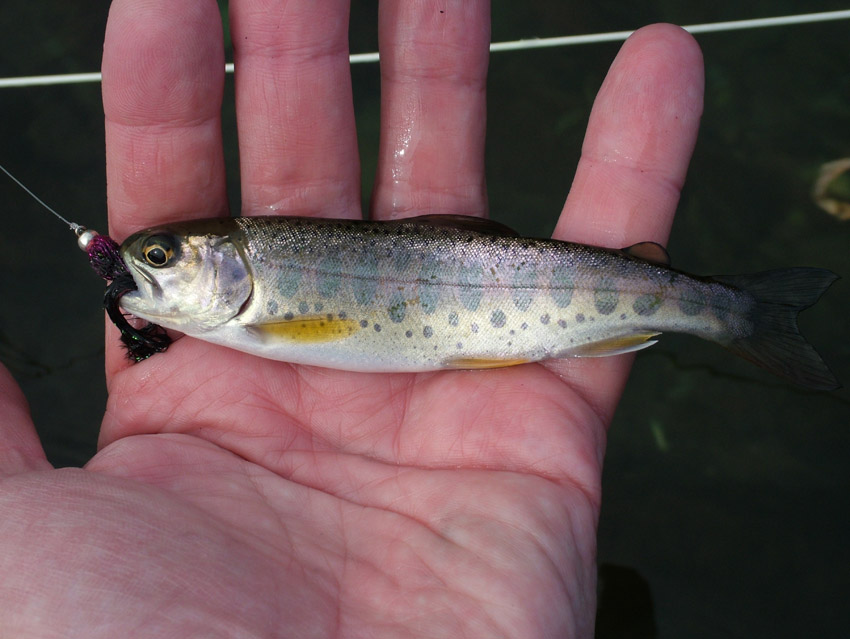
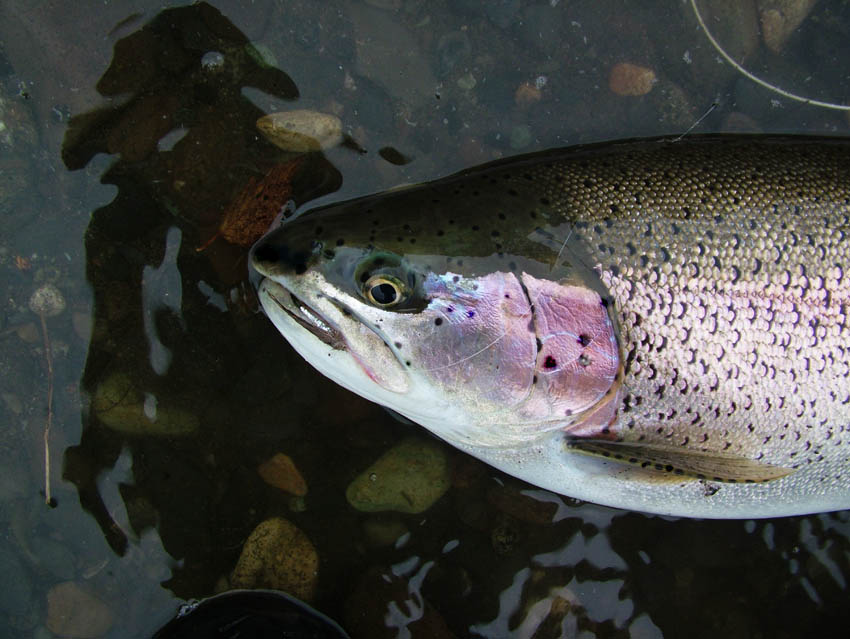
it is a resident salmon (female). It came into the river in autumn or in early spring, in May. Photo -July, Chavanga river,

This one was landed with dry fly may fly spinner but not in a hatch.

This summer was very interesting situation- hot and low water level. It was not good for fresh salmon run to the river. But it is great time to fish resident salmon and to see all best places of the Chavanga river. I was surprised of very high salmon activity in 23-24 water temperature. But spawn period began early - in a middle of September.
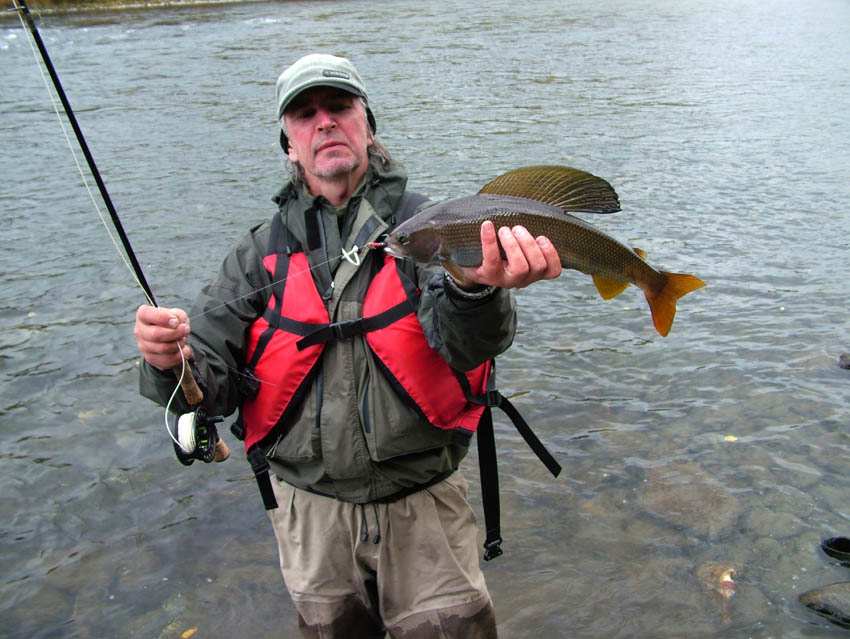
This Chavanga`s salmon was landed with dry Black Sedge in a middle of August

Red Tag is effective fly not only in a middle of summer. If you can present it correctly it works all season. May be red color does..
Olive sedge pupa- very effective fly for salmon fishing. Without any jokes. Only need to present correctly, you know.
------------------ Here is Hewitt's book on dry fly fishing (one of the fathers of dry fly salmon fishing)
Secrets of the salmon

------------- Have you tried a San Yuan Worm dry fly (bit of red microchenille burned on ends and cinched onto a light tiny hook with a few wraps of tying thread so it floats)? Works well in hot water and stale smart fish.
-------------- Your leader looked a bit thick in one of those first shots. We find thin clear leaders help with smart resident fish in warm water.
------------- Another small dry fly for you to try is a crimson butt buck bug (tail end of body 1/3 or so is red deer hair, next 2/3 of body is natural deer hair, body palmered with yellow grizzly hackle all this on a small #8 or #10 hook or smaller).
--------------Also a green machine tyed with a thin body...
-------------- Tiny #12 or #14 black ants are deadly! As are tiny black crickets skated like a caddis.

-------------- A huge mucelin soaked heavy deer hair dry fly with sparse hackles smacked on their heads with a bang works sometimes too (a savage take!).
-------------- Very very fast strips with a tiny #14 unweighted nymph on a strong hook works too in warm water with stale fish.
---------------Do you have grasshoppers up there? I doubt it.
Silverleapers: Here is a page every atlantic salmon angler should read:
The surface feeder
And a peer reviewed scientific paper that shows they feed:
Evidence of freshwater feeding by adult salmon in the Tana River, northern Norway - Johansen - 2005 - Journal of Fish Biology - Wiley Online Library
--------------- Its all about "catching them in the act" of feeding (these are fresh run fish NOT un spawned and over-wintered fish or post spawn kelts). They don't gorge themselves everyday or actively search for food like a non-anadromous trout. They have other things on their minds (migrating and spawning), but sometimes they are resting in a lay that has a lot of insects floating by. Even sea run trout and char can be hard to catch on a fly after they have been in freshwater for awhile.
-------------Like the old wives tales about salmon not swallowing insects, most North American's thought Arctic char would not take a fly. This of course was ridiculous, and stemmed from writers that had encountered difficult to catch char that had been in freshwater for awhile and were coloring up.
--------------Gut some fish and examine stomach contents for a while - you'll see insects.
My first info about salmon freshwater feeding was polish journal Pstrag&Lipien, two articles by Stanislaw Cios in #1 1995 and #3 1995. I don`t know is it possible to find it in library. He show several observation and documents and give us a common decision about possibility of salmon to interest, to attack, to eat.
Some time in summer and during autumn this BH Red Tag variant fish very well.

".....This June on Chavanga river some hot days have warmed up water unusually early, the River remained as in spring high and rather turbid from an impurity of peat from the overflowed bogs. Such combination not too is pleasant to fishes, at them character and appetite on spring salmon is corrupted. Usually we pass to smaller and more modest flies, but wished all the same have not received. Or fish absolutely wishes nothing or it is necessary to change techniques of catching. It seemed to me that on large flies does not peck, and small I cannot spend as it is not necessary, I can achieve their correct position in water. ...."
I put this little note about nymph salmon fishing on my site Chavanga - Home in blog (April issue). Later, in July and August in low water condition there was not difference between salmon and grayling reaction on nymph ant method of presentation.
----------------------------. By the way, what type of hooks do you tie your dries on? I suppose they are much stronger than the average trout hook

I already had some experience of fishing on usual wet flies which hardly you will carry to the salmon. For example, the salmon always not bad concerned flies with a metal head which could play a provoking role or to serve as an imitating detail. In some cases, the metal head, first of all, improves fly presentation to keep it in a current or in deep places where it is not easy to get on level of the fish nose. Only 100-th gram, but for small fly it is a huge difference. And additional 15- 20 centimeters of depth are essential to such bait.
But in high, moreover and rather turbid water standard variants have seemed not absolutely effective. If have gone on this way it was necessary to connect them on tungsten heads (Bead Head Nymph). Only in their weight I can explain revival of interest of a salmon to a fly.
Distinctions between some wet flies and nymphs are rather conditional. More than that, the difference of classification groups is defined sometimes not by anatomy, but presentation method. When in a hand there was a fly with a tungsten head, it became clear that the fly has outgrown frameworks wet and it is time to catch it, as the nymph. And cast to do not across and downwards, but to throw it upwards and across, to make standard nymph cast.
I use standart Kamasan trout hooks or Maruto wet fly hooks # 10-12, a combination of #6 rod and 0.25 tippet is good to safe this hooks alive. I notice that small hooks with short shanks don`t want to destroy. And delicate tackle set safe it too. In my practice I did`n lost more fish with small flies than with standart salmon hooks. Tippet is a problem when you need to land big fish in "bad" place, in rocks.
---------------------- X-fine dry hooks is not good idea!!
But if you fish not a huge salmon, but 2.5-4 kg, ordinary dry flies for graylings or trouts you may use without any troubles. The main target is to provoke fish attack (presentation) and to land fish is only a second target, i think.

It's interesting that it's not at all unusual to pick up a salmon whilst Czech nymphing on the Welsh Dee in the autumn.
--------------- “There is no more lovely country than Monmouthshire in early spring. Nowhere do the larks sing quite so passionately, as if somehow inspired by the Welsh themselves. There is a blackbird on every thorn and a cock chaffinch, a twink as they call him there, on every bush...... It moved me profoundly. I had been spared to see another spring, and I thank God for it.”
Oliver Kite
“A Spring Day on the Usk”
A Fisherman’s Diary
------------------- We use bead-head nymphs down here for salmon, but it's as a mechanical aid to getting the fly deep rather than anything to do with catching resident fish. The rivers are very small and have deep pools known as pots where the salmon can lie-up for most of a season, with the fresh fish coming in from summer to January.
-------------------How do you observe the feeding behaviour in these fish you have?
First of all, I have noticed that the salmon actively attacks a fly when grayling is active too. Means, conditions for display of activity of these fishes can be identical. It concerns conditions of water, the river and - 2- concerns possibilities of presentation of a fly.

For me the fact of documenting of interest of a resident and a silver salmon to imitations of insects and influence of conducting on attack frequency was important. I alternated a method of "a wet fly" with "aggressive wet" and catching on the nymph downstream. On reaches, rifts and other places I tested serially 2 or 3 flies, replacing successful and trying the new.
Steams of flies The Relation of number fly effectiveness
grayling to a salmon T/S
1. Black Zulu Wet 1: 2 Stable attacks
2. Orange Partridge Wet 2: 1 Interest is changeable
3. Red Tag Wet 1: 1 Constantly well
4. Partridge&Orange Wet 3: 1 The impression is pure grayling
5. Bead Head Pheasant Tail The nymph 1: 1 Took any fish you located
6. Olive Sedge Pupa Wet 2: 1 Well, but it is not always constant
7. March Brown Wet 3: 0 Does not work On the sun
8. Olive Sedge Pupa Wet 1: 0 Interest is changeable and at grayling
9. Bead Head Pheasant Tail The nymph 2: 1 Calls biting activization
10. Partridge&Orange Wet 0: 0 Absence of interest
11. March Brown Wet 1: 5 during a rain took each fish
Caddis Green Butt Pupa Wet 0: 0 Absence of interest
12. Brown Bomber Wet 2: 1 Half-heartedly
13. Green Sedge Wet 2: 1 Languid attacks
14. Stonefly Nymph The nymph 1: 3 Stable interest
15. Bead Head Caddis Nymph the nymph 1: 5 Took each localised salmon
16. Bivisible and silver Dry/wet 1: 1 Stable attacks
17. Red Tag variant Wet 1: 1 Constantly well

This statistic I got some years ago on Chavanga river, Kola. River is very changeable during a season and it is very interesting not only to land fish but to see what is happened in the water. We may see something in a low clear water, you understand, that the best time to observe wild life is low water summer. I can see reaction of a salmon on my fly directly, as in grayling fishing in my Belarus or Poland rivers. I show my fly and can see fish movement, rising, following and attack. Now I think that salmon can do analysis, observation of a target only in a way trout and grayling do it. And all methods of traditional fishing and all flies can work for salmon. We may go far away from a simple attractor fishing using "salmon" flies, methods and tackles.
------------------ I have caught salmon in Ireland on dry Mayfly on the rivers in June in Low water conditions with bright sunshine, it seems to work better if there is an upstream breeze to put a small wave on the water. I was told by an old ghillie that the wave puts more oxygen into the water which switches the fish on and makes them active.
-----------------I have also used a dry Royal Wulff on a size 1 low water iron to get King Salmon in Alaska, very interesting to watch them rise very slowly from maybe 5' 6' down to inspect the fly closely before taking.
------------------- Here in Iceland we had a very long period of drought last summer and somehow this seams to be the norm as the summers here are getting warmer and warmer each year. This is very frustrating scially when large shoals of salmon are lying in the pool in the gin clear river and are just not taking.
The usual method here in Iceland is to start with a very long leader and a micro fly and stand very far away from the pool in order not to be seen. This often gives results but I would like to mention one method that works very well in situations like mentioned above.
------------------- Last summer I was fishing Hrutafjardara a small river on the northern side of Iceland. The pool was packed with salmon and the temperature of the river was well above 16°
After casting every available fly in my box and trying all sort of different methods I remembered one advice I once heard.
That is to fish the pool upstream.


The salmon is in a way lazy as the hot water in the river takes out all spirit from the fish. The lower water levels also means that the salmon lies much closer to the surface and can therefore spot the angler much easier as the angle of its vision is much wider than in normal situations.
Therefore you fish it like trout upstream, that is you stand well below the pool and cast the fly and make sure to strip the line as the fly comes drifting down the pool . By applying this method I managed to hook two salmon last summer after have tried every fly in my box with different methods, stripping, hitching and so on.
The best lesson learned from this is that later that summer I tried this method with a double hand rod on a large river (East Ranga) with a large brass tube where the water level was normal, and it works I hooked a salmon after have fished the pool with more traditional methods.
I believe that fly fishing is all about presenting the fly in order to provoke the fish. If the fly goes the same way through the pool like with "normal casting" the fly becomes a part of the environment. When you think about the amount of flies some salmon manage to see through the season it is a little miracle when the fish decides to go after your fly.
When the fly is presented drifting on the same speed as the running water it all of a sudden becomes something totally different and provocation occurs.
This method is something that I highly recommend as a last resort when everything else is tried or as a first option when water levels are very low.
Tight lines, Laxaonline.com

---------------Kolbeinn, very interesting thought, sometimes it happens iam confused about the flies and methods, never came up with an idea to land inactive salmon by fishing upsteam.
Chavanga river experiments
This autumn there was successful way of salmon fishing at the water surface. The Chavanga river water level was low, and fish hid in holes between stones on river main current. It did not react to usual provocative salmon flies, despite that we have reduced their size till 12-14 number. Probably, in crystal-clear water fish perfectly saw all lacks of an artificial bait. Fly deduction in one place, its acceleration upwards against the current or movement across did not interest a salmon. But we have found a way. In places where in the tideway of the river there were many large stones, there was effective a way of provocation of a salmon on becoming wet dry fly. The fly of type CDC sedge after wet remains in a superficial film of water. At a stop of its drift over parking of fish, the fly forms a small hillock of water directly at surfaces. This easy wave is well visible to the fisher and it is possible to supervise fly`s movement.
At the moment of a stop of a fly and hillock occurrence on a surface fish rose from shelter more often and attacked. The cast distance and presentation did not exceed 5-7 meters. Among stones it was possible to approach imperceptibly and to fish carefully all possible shelters. There was a problem of nylon strength. The salmon ignored thick tippets also, as well as the big flies. It was necessary to apply fluoro-tippets 0.20-0.22 in diameter. Diameter of 0.25 has seemed already too rough and appreciable in water. We have lost a part of large fishes, as it is very difficult to land such fish among stones. To such flies I have not noticed any color preferences. Probably, the fact of appearance of a hillock on a water surface was the main thing.
--------------- looks more like (close range) hitching with a subsurface fly you do there. Must be breathtaking to see a salmon rise to it!
--------------------------- Glad you can post pictures, keep them coming! I've got a piggy-bank with the word Chavanga written on installed on my tying desk ! See you in a couple of years
Here one Atlantic salmon on BH nymph and Gorbusha with weighted nymph too.
Both were landed on BH (tungsten) nymph, not imitative but really fantastic orange + red fly. This combination of colors sometimes is magic, a reason- may be a color of eggs, fish caviar has the same color and all fishes, salmon, trouts, graylings remember it. In this situation we may use a very little fly to fish successfully. It gives us more variants in fishing method choice. I think.
Allow me to tell about one amusing way of fishing of a salmon. My cousin who has come back from a trip on the White sea, to the Arkhangelsk region (Russia) has told to me about it Russia. In these deaf places Local residents do not fish on a fly, spinn lure is a problem too. Here always caught a salmon on a worm, threw a sinker and held a nylon in a hand. But technical progress knows no limit. The novelty of last years consists in fishing of a salmon that the hook with worms is located now in a condom. Such vibrating bait on fast waters provokes a salmon on attack. Remains not clear, what role is played now by worm? Whether it is necessary to save and watch tightness of a condom?
--------------- How often it is necessary for changing?

In a photo the local resident who throws a bait. He uses an ordinary can as spinning reel. The nylon easily comes off it at cast. The fisher keeps a bait on a current, and then, retreive a bait, reeling up nylon on bank.
------------------ What a story, This shows the inventiveness of locals presumably not fishing for fun, but for food. Does this mean we're going to have to tie "condom flies" when we come to Kola?
! Yes, sometimes we need to open a door in a sexual life of salmon!
My son has told about this case to me. For one of days there was a hutch off small mayflies. Everywhere were visible traces of graylings which attacked emerging nymphs and insects on a water surface. We have found suitable flies, I was fishing wet variants, the son caught on dryfly . In this place water moved from coastal stones in a direction to the river centre. The majority of graylings attacked flies when they moved in the same direction, from coast to the centre. We tried to simulate both an insect and its natural movement. It was interesting that here on depth of 1/2 metre a CDC may fly #18 was attacked by silver salmon. After short struggle salmon has break a tippet and has left. In my opinion, in a fishing technique was very little provocative, we fished and tried to imitate as much as possible to present real insects.
------------------------ The water level seems to be very low, which month is it on the pictures? How does it effect activity of the fish there? Thanks!!
It was the middle of August last summer, extremely hot and low water for all Kola peninsula and for Europe too. You know, fresh salmon stopped it`s run from sea, but resident fish was very active. It was surprise, but in 20 - 22 degr. warm water salmon was angry and fishing was excellent. May be low level water provokes fish. But trouts disappeared, and I saw it only in September when new sea trouts came to the river.
I always assumed that the salmon is interested in details of red or orange colour. Here again on a photo the fantasy nymph prepared for grayling has brightly-red tail. But often the salmon chooses flies as well as grayling , therefore red details are at all unessential. But it is necessary to consider that natural colours of a bait assume natural presentation of a fly, the correct method of fishing and corresponding structure of tackle is necessary..
------------------------What a wonderful read! Reminds me of the things we are doing here in NL, Canada. Atlantic salmon are just another trout.
-----------------------Have you tried "bombing" them yet? To do this we soak an appropriately sized bomber in heavy Mucelin paste so that it is heavy but floats like a cork. Then one can do tucked type casts so that the fly lands with a smack onto the water surface but it still is on a slack leader after it lands. If you hit the fish right on the head with the heavy dry fly repeatedly it will often make a savage take. This works on stale fish in warm water and fresh fish in cool water. Its hilarious. One guest called me the "lion tamer guide" as I was whipping the fish into submission! This is not a feeding response but rather a territorial response - I think.
Here is an article I wrote about sound and dry flies and how to use sound to help catch fish hiding behind ledges and rocks and blinded by sun , etc.
http://www.eurekaoutdoors.nf.ca/dryf...sentations.pdf
Sound can be a critical tool used for hooking salmon.
About sound- it is a detail of correct presentation! I observed many times how some anglers lost this very important detail of presentation- first sound of "bombing", that starts salmon interest to fly. A lot of casts trying to cast far and another mistakes. Not a cast - but presentation! First cast is very important from this position.

To me it is pleasant that last years I meet many fishers who do not put for itself aim to catch much and much. For them possibility to catch a salmon in different methods is interesting. This year group which set as the purpose to catch a salmon on a dry flies came again. Certainly, it was possible to argue on, whether the dry fly can be considered as the imitating. But the salmon attacked flies in a dead drift both on Chavanga and on Strelna river. Fish was both sea silver fresh and local, resident .
It is interesting that salmon fans of the nymph were especially successfull . Here too there were many questions, but the nymph has surpassed usual salmon techniques in productivity. I hope that I can prepare a material and show it here.

Now I already easy concern catching of a salmon on the nymph. I can specially catch it on the nymph. But me still difficultly to change quickly a usual salmon bait for the small nymph. I do not have not enough mobility. My friends tried to change fly quickly if there are no attacks of fish. It helped us to catch some more fishes. In each good place it was possible to catch some more salmons, it is necessary to change a salmon fly for the nymph only. I applied the nymph with an orange body. But it has appeared that this colour is unessential. My friend Massimo successfully caught fishes on the various nymphs. More often the presentation of the nymph was beyond a nymphing method . But the salmon pecked. Here is a photo of other nymph of olive colour also. It unequivocally has natural colour and a kind. It is interesting that fresh fishes came across. Our friend Antonio caught specially only on dry flies. It used a stimulator and bomber. Both resident fishes and fresh sea salmons showed Interest .Antonio caught so most fishes. On the statistican from the rivers Chavanga and Strelna he has caught 36 salmons and has lost 23
Silverleapers! Very interesting article, thanks! I have just returned from fishing from Kolsky peninsula and I want to tell the following. Earlier, I paid attention to blow by a fly on a water at fishing white fish. At salmon fishing I noticed that fish attacks often at once as soon as thefly falls on water. But to throw a flyit is necessary purely. The salmon stops to react to a bait after several blows by a line on a water. First cast often happens the most important. If we correct a line position on water or we use false casts, interest of a salmon to a surface disappears quickly . I asked once my friend Richard about when does the salmon attacks a fly, on which second after cast? He answered that at once. As soon as fly falls on water. He was able to cast so without superfluous noise. During the periods when a water level low, to throw so that fish heard only a fly, it is very important. So was this year on Chavanga and on Strelna. So we need to change our casts and presentation, our tackles too.

Here you see the nymph with a tungsten head. I already mentioned it earlier, and now have found in old photos.
Here again a humpback salmon caught on such nymph in July. And initially I caught it salmons in the beginning of June in high but already warm water.
Feature of a fly- the small size for inactive fish, tungsten head for fly presentation on depth and accent of metal shine in a combination to a blood-red synthetic body.
Color is very popular among Chavanga river salmons.
Next two fishes, pacific salmons -humpback, resident and silver were couched by nymph in Chavanga river, Kola.
Method of presentation - cast little upstream and across stream on a slack line, some seconds of dead drift for deeper presentation.
And after fly passed you downstream - gently stop it following by rod tip. Now fly will rise up and fish attacks it.
Chavanga,
Czawanga, Strelna river, salmon fishing in Russia, peche au saumon Russie,
pesca de salmon Rusia, pesca del salmon in Russia, fiske lax, lov lososu v
Rusku, fang von lachs in Russland